|
| |
|
Waveform Spline
Optimized One Dimensional Curved GRG Canopies
From The Acoustical Industry's Leading Innovator |
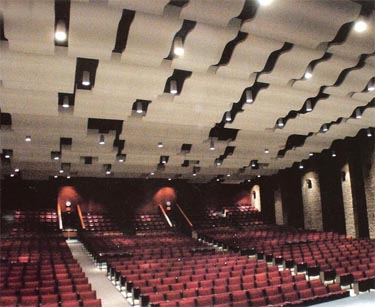
Overhead canopy arrays are used in auditoriums to blend the direct and early reflected sound, increasing speech intelligibility and enhancing musical clarity and intimacy. Traditionally, non-optimized, periodic flat panels or arcs have been used and their placement has been either aesthetic or based on geometrical optics. If not properly designed, tilted, and arrayed, a canopy can provide uneven coverage, typically exemplified in minima and maxima in the sound pressure level. in addition, these simple shapes can be diaphragmatic, leading to a loss in low frequency sound. To solve this problem, RPG developed a powerful shape optimization software, which optimizes the shape, tilt, and arraying of the canopy array and eliminates all of the guesswork. The Waveform Spline is an optimized one dimensional wavy panel that provides uniform coverage over the entire stage or audience area. Novel, Class A, fire safe, honeycomb GRG composites also minimize diaphragmatic absorption.
|
|
|
|
Problem
Flat panel arrays provide uneven sound pressure across the audience area. Listeners experience sound level minima when the geometrical reflection point for a receiver is between panels. Coverage can be improved by curving or shaping the panels, but there is no guarantee that optimum results will be obtained, and consequently, uneven response is often still experienced.
Solution
To solve this problem, RPG developed the first Shape Optimization program, which automatically determine the best shape, tilt and arraying to insure uniform coverage. The Shape Optimize combines the power combine the power of the boundary element and multi-dimensional optimization techniques, incorporation the diffusion coefficient as the metric of optimal performance. The Waveform Spline provides optimal ensemble for musician on stage and uniform coverage in the audience. Each canopy element has the same optimal shape for aesthetic reasons. However, each panel’s tilt is independent. This insures optimal coverage on stage and in the audience forestage seating area.
|
Performance Specifications
|
Distance, m
|
Shape Optimizer
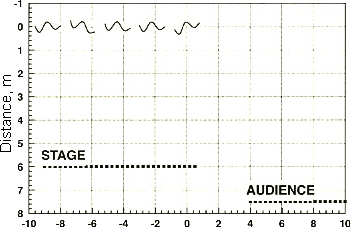
In Fig. 1, we show the canopy section, sources/receivers on stage and receivers in the audience. In Fig. 2, we show the sound pressure level (SPL) at musicians’ ear level over the entire stage form a source in the middle of the stage. The canopy is flat and extends across the entire width of the stage with gaps as shown in Fig. 1. Note the level is constant across the stage, but there are severe dips and peaks front to back. The Shape Optimizer examines thousands of potential canopy shapes in attempt to provide the most uniform coverage possible, based on the size and shape constraint imposed. Fig. 3 shows the dramatic improvement over the flat panel canopy. The standard deviation from uniformity (0 db is uniform coverage) is plotted in Fig. 4 for the flat panel, a 5’ and 10’ radius traditional arc, an angled panel, and the optimized Waveform Spline. The improvement is dramatic.
|
Figure 1. Canopy section |
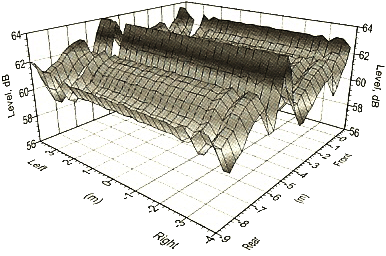
Figure 2. Sound level from flat canopy
|
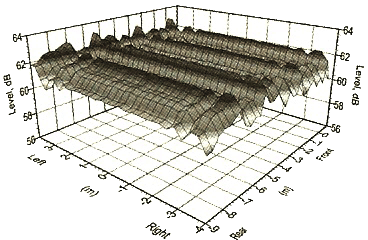
Figure 3. Sound level from optimized spline canopy |
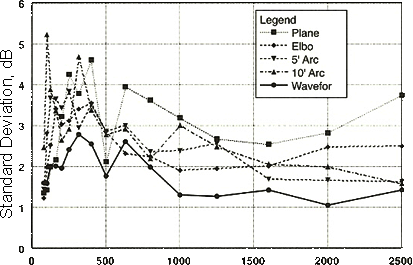
Figure 4. Diffusion response comparison
|
 |
Installation
IInstallation is simple using integral metal hair pin connectors. Simply attach suitable supplied engineered cables for dead hung installation. The image to the far right illustrates how the Spline panels can be seamlessly joined end to end forming an arc. |
|
|
|