|
|
|
| |
Sound Barrier |
|
|
|
|
|
| |
Acoustic Infill |
|
|
|
|
|
|
| |
Damping |
|
|
|
| |

print |
| |
|
| |
|
| Damping Sheet PVA Based |
|
Description
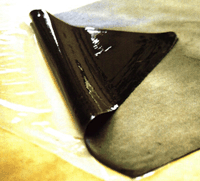
PVA Based Damping Sheet is a light weight, visco-elastic polymer material, manufactured from polyvinylacetate.
It is designed for use in acoustic applications, where a high level of vibration damping is required to reduce noise radiating from lightweight sheet metal. It is suitable for use in clean room environments.
PVA Based Damping Sheet is supplied with a full self-adhesive backing and is available in sheets or can be die-cut to size and shape.
Colour - Grey
Application
PVA Based Damping Sheet is used extensively to reduce vibration in flat resonant surfaces, particularly from vehicle panels, machine guards, industrial plant, stainless steel sinks and preparation tables.
|
Operating and Application Temperature
PVA Based Damping Sheet can be used on substrates operating at continuous temperatures between -35℃ and 100℃. It will withstand intermittent tpmperatures up to 160℃,
For ease of application, PVA Based Damping Sheet should be applied when the ambient temperature is between 18℃ and 25℃.
Fire Performance
PVA Based Damping Sheet meets the requirements of FMVSS 302/ISO3795.
Storage and Handling
PVA Based Damping Sheet should be stored between 18℃ and 25℃ and allowed to stabilise at room temperature prior to use. PVA Based Damping Sheet should be kept in a dry environment and used within 6 months of purchase.
Acoustic Performance
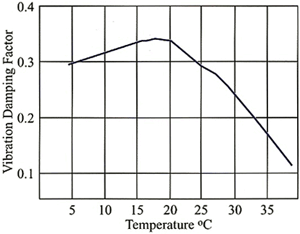
Vibration Damping Factor: the vibration damping performance of a material can be defined by its 'damping factor'. This is the ratio of the material's damping to its critical damping. Critical damping is the smallest value for which a sample does not vibrate when deflected and released. It is also a temperature dependent property. For PVA Based Damping Sheet, optimum damping is achieved between 15℃ and 20℃.
|
Acoustic Performance
Dimensions and weight
material |
Thickness
mm |
weight
kg/㎡ |
sheet size
mm |
ordering reference |
PVA Based Damping Sheet |
1.4mm |
2.6 |
1600x1000 |
DSF2 |
|
|
Application and Fixing
To obtain optimum bond strength from the self-adhesive backing supplied on PVA Based Damping Sheet follow these instructions: |
1 |
Allow to stabilise at room temperature prior to use. |
2 |
Apply in the horizontal or vertical plane. Where there is a requirement for the damping sheet to be applied to the underside of a substrate, the substrate should be turned upside down if at all possible. The damping sheet can then be applied to the underside from the horizontal or vertical plane and left until the adhesive has fully cured before turning the substrate back to its correct position. If re-orientation of the substrate is not possible, the damping sheet can be applied from the underside providing it is supported against the substrate until the adhesive cures. |
3 |
Clean and dry the substrate with an appropriate cleaner i.e. methylated spirit or similar so that it is free from oil, grease, rust, dust or other particles. For applications onto timber substrates, the surfaces should be prepared using a primary coat of A3038 Neoprene Adhesive, available from Hodgson & Hodgson Group Ltd.
|
4 |
If possible, gently preheat the damping sheet to 30℃ and apply when the ambient temperature is between 18℃ and 25℃. Do not subject to direct flame. |
5 |
Peel off the protective backing, position material onto substrate and apply a constant forward and downward pressure to the surface of the damping sheet to ensure it is securely fixed onto the substrate. A hard timber or steel roller is recommended for this purpose. |
6 |
Particular care must be taken to avoid forming air pockets between the substrate and self-adhesive backing, as this will weaken the bond and reduce the vibration performance. |
|
|
|
