ผ๒ฬๅ ทฑ๓w


Sound Barrier
 
Acoustic Infill
 
Damping
 

print
 
   
DuctLag

Description
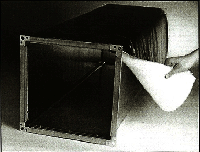
DuctLag Acoustic Blankets comprise a range of products manufactured from various combinations of glass fibre, melamine foam, polyester blanket, lead or polymeric barriers. The resulting composite panels are faced one side with a reinforced Class กฏOกฏ aluminium foil.

They are designed to control noise break-out from rectangular or circular ductwork and pipes by isolating noise within the duct or pipe from the outside environment.

Colour Outer surface finish - Silver

Design and Application


DuctLag A

Is manufacture from two layers of glass fibre with a lead core .It is extremely flexible and forms easily around curved surfaces .The inner layer of fibre is quilted with a scrim backing and the outer layer is faced with a Class 'O' aluminium foil. DuctLag A is suitable for use in applications requiring high levels of thermal and acoustic insulation.

 
DuctLag T
Is a composite panel manufactured from profiled melamine foam adhered to a barrier mat with a Class 'O' aluminium foil on the outer face. The profiled inner face enable square corners to be formed on the edges of rectangular ductwork. DuctLag H is suitable for use in กฏclean roomsกฏ and hygienic areas and is used extensively in hospitals pharmaceutical plants and food production factories.
 
DuctLag P
Is a cost-effective, non-irritating layer of polyester adhered to a barrier mat with Class 'O' aluminum foil on the outer face.
 
DuctLag H
Is a singe layer of acoustic barrier mat with a Class 'O' aluminium foil on the outer surface.

Operating Temperature
The outer face of DuctLag Acoustic Blankets can with stand direct with temperature up to 90กๆ.

Fire Performance
Ductlag Acoustic Blankets comply with the Class กฎOกฏ requirements of the Building Regulations, when tested to BS476: Part6: 1981 and Part 7: 1987.

Thermal ConductivityกกกกDuctlag A and P 0.037กกW/mK @ 10กๆ
Acoustic PerformanceกกDuctlag H 0.035กกกกกกกกW/mK @ 10กๆ

The Figures below are typical of a cross section of 200mm ductwork:

Product

insulation thickness
mm

barrier weight
kg/m2

typical reduction in noise breakout dB

125
Hz

250
Hz

500
Hz

1000
Hz

2000
Hz

4000
Hz

DuctLag
A,H,P

12
25
50
12
25
50

5
5
5
10
10
10

4
1
2
2
4
4

1
4
6
5
6
10

8
12
14
12
16
18

16
17
18
18
20
22

18
19
20
22
24
26

20
21
23
23
25
29

Dimensions Density and Weight

Product

nominal thickness
mm

blanket size
mm

density of insulation
kg/m3

weight of barrier kg/m2

ordering reference

DuctLag A


DuctLag H


DuctLag P


DuctLag T

25
50
75
25
50
75
12
25
50
12
25
50
12
20
40
12
20
40
2.5

2000x1200
2000x1200
2000x1200
2000x1200
2000x1200
2000x1200
2000x1200
2000x1200
2000x1200
2000x1200
2000x1200
2000x1200
2000x1200
2000x1200
2000x1200
2000x1200
2000x1200
2000x1200
2000x1200

glass fibre inner face
16 kg/m3
glass fibre inner face
24 kg/m3


melamine foam
9.5 kg/m3กภ1.5


polyester blanket
15 kg/m3


n/a

5
5
5
10
10
10
5
5
5
10
10
10
5
5
5
10
10
10
5

A512
A525
A550
A1012
A1025
A1050
H512
H525
H550
H1012
H1025
H1050
P512
P525
P550
P1012
P1025
P1050
T5

Application and Fixing
To ensure optimum performance from the application of DuctLag Acoustic Blankets it is important to follow these instructions.
DuctLag A, H and P
1. Wrap DuctLag around the ductwork or pipe taking care to overlap the lead barrier by at least 50mm. This can be achieved by paring back the lower layer of glass fibre, melamine foam or polyester blanket from the quit and the upper layer of the glass fibre, melamine foam or polyester blanket from the lower quit. This will expose the lead barrier cores enabling them to be overlapped as shown in the diagram below.
2. Seal the joints with DuctLag jointing tape available from Hodgson & Hodgson Group Ltd.
3. Where more than one blank of DuctLage is required to complete the application, the lead barrier core should be overlapped along all joint as detailed above.
4. Carefully cut DuctLag around any valves, brackets or other penetration, ensuring it fits tightly around the obstructions. Seal all the joints with DuctLag jointing tape. Failure to create a snug fit between the DuctLag and the obstruction as well as sealing the joints could adversely effect the acoustic performance.
5. Support DuctLag around the ductwork or pipe using either non-metallic banding at 500mm spacings or tightly wrapped wire netting
DuctLag T
6. Wrap DuctLag T around the ductwork or pipe taking care to overlap both vertical and horizontal joints by at least 50mm.

กกกกกกกกกกกกกกกกกกกกกกกกกกกกกกกกกกกกกกกกกกกกกกกกกกกกกกกกกกกกCLASS"O" aluminum foil outer layer
กกกกกกกกกกกกกกกกกกกกกกกกกกกก jointing tapc


กกกกกกกกกกกกกกกกกกกกกกกกกกกกกกกกกกกกกกกกกกกกกกกกกกกกกกกกกกinner layer of glass fibre, mclamine foam or
กกกกกกกกกกกกกกกกกกกกกกกกกกกกกกกกกกกกกกกกกกกกกกกกกกกกกกกกกก polyester blanket


กกกกlcad or polymeric barrier core